


Services
Design, development and production for 3D printing. That is what we do.
What we do
Some clients come to us with a fully developed 3D model and want it produced. Others come with a sketch, with an idea, or simply with the question of whether something can be printed at all. We work across that whole chain: we are engineers and designers by background, and we have been printing at large format since 2018. We are glad to think along about form, material and build-up — all of it in service of production, because that is the core of our business.
Your project does not only have to be possible to make. It also has to be quick to produce, not cost too much, and put as little strain on the environment as possible. That is what we advise you on. Not from the sidelines, but as an experienced manufacturer with a shared interest.
Large-format 3D printing
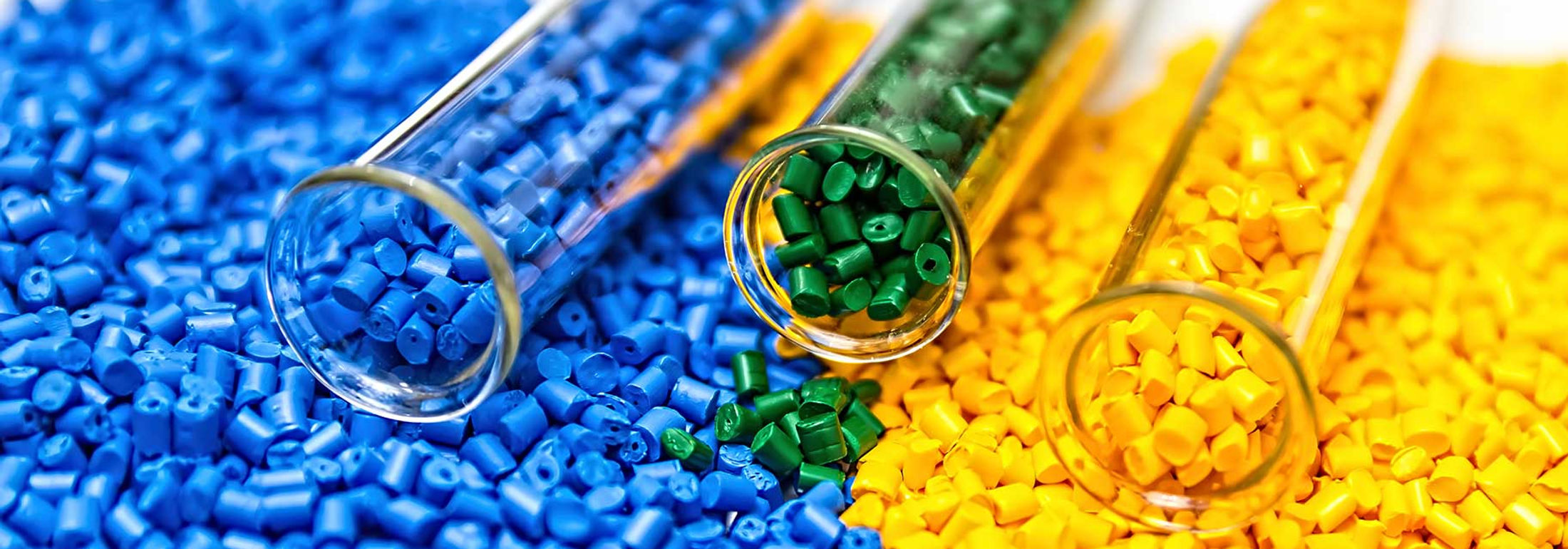
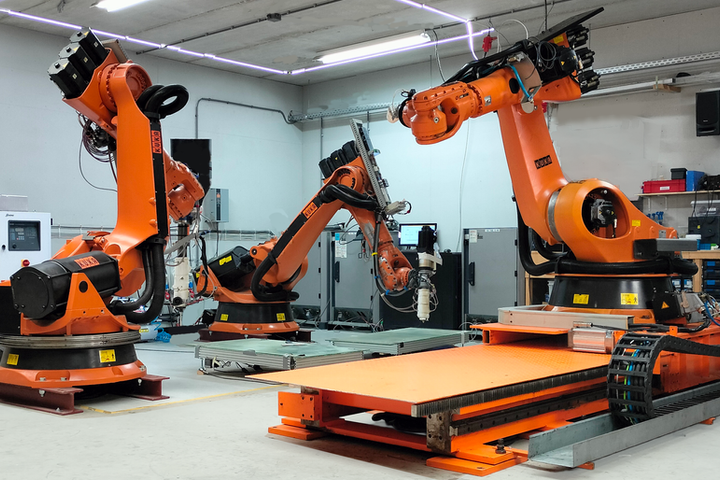
We print on six-axis KUKA robot arms with extruders we developed ourselves, our own control system and our own software. The process is called FGF — fused granulate fabrication, also known as pellet extrusion: we print from plastic pellets instead of from filament. That makes large volumes and high deposition rates possible.
In a single piece we print up to roughly 2.5 metres long or wide, 2 metres high and 1 metre deep. Assembled from several parts it goes much further: the bodywork we printed for TRABOTYX consists of five parts and together clads a machine measuring 2 by 3 metres and a metre and a half high.
No mould is involved. That saves not only the cost of that mould, it also means every product may be different without the price rising along with it.
From idea to printable product
Most products are not simply printable. That is where our work lies.
A sketch, a 3D model, an existing product that has to be made differently: we translate that into something the printer can make and that does what it needs to do. And we do not stop there. We always look for what the product can do beyond what was intended — a function that is gained, a part that disappears, a step that becomes unnecessary. That gain is almost always there, if you think it through properly.
The clearest example is ADORE. The original design was a fixture on a steel support structure on a concrete foundation: three parts, three production methods, three cost items. We drew the base plate, the holder and the diffuser together into one printed product, from one material, in one automated process. That made the project feasible — not because printing was cheaper than the original method, but because parts disappeared that would otherwise have had to be made separately.

Materials
We print exclusively in recycled and biobased plastics. Virgin material is not needed for that: there is almost always a suitable waste stream available.
We work with ABS, PLA, HIPS, PET-G, PP and polycarbonate, among others. Reinforcing fibres can be added to almost all of those materials: plant fibres such as hemp, miscanthus, wood and cellulose, or glass and carbon fibre. Where the application calls for it, additives come on top of that, such as flame retardants or UV stabilisers.
We do not do coating ourselves. We prefer to find the solution in additives, because a coating is hard to separate from the plastic later on and that sometimes comes at the expense of recyclability. If an application does call for it, that can be arranged.
The process produces little waste. Material that comes off and products that have reached the end of their life go back into the printer.

Post-processing
Where necessary we post-process our prints. We sand and mill — by hand or CNC-controlled, for recesses, holes, fits and milled-in logos — and fit inserts such as heat-set and press-fit nuts or rivet nuts, so that a printed part can be screwed into a larger structure.
Sometimes post-processing is not needed, and sometimes a client prefers to do it in their own workshop. We look at what makes most sense project by project.

Small-format 3D printing
Not everything is large. We have professional desktop FDM printers, fully set up for unattended batch production: material dryer, multi-material unit and batch software. Our small printers can run the same print strategy as the large ones, so that a prototype of a large-format product really does behave like one.
The work is varied: prototypes and finish tests for a large-format print, small series, and full engineering projects that happen to fall within the reach of a small printer.

When printing is not the answer
3D printing is not always the right choice, and we would rather say so straight away.
We lose out to mass production as soon as large numbers of exactly the same product are needed. For ten thousand identical parts you should not come to us — injection moulding or another form of series production is almost always cheaper then.
We win as soon as variation comes into play. Smaller runs. Series in which every product is just that bit different — with moulds you pay again for every variant, with us you do not. Shapes that cannot be released from a mould: traditionally impossible, for us a matter of course. And sometimes printing wins on size alone, because a product is larger than rotational moulding can handle.
Printing is attractive when a design is not yet fixed, too: as long as you are iterating, a change costs a new print rather than a new mould. At TRABOTYX the design was even adjusted halfway through a run of ten.
Two things we do not do at all: injection moulding, and milling as a standalone service. If you come to us with an existing product that only needs milling or moulding, you have come to the wrong place.
Discussing a project
Do you have an idea, a sketch or a model — or an existing product that has to be made differently? Or are you unsure whether 3D printing is really the right route here? Put it to us, and we will tell you what we think.